Meet Francis and Claire,
your new favorite romantic couple:
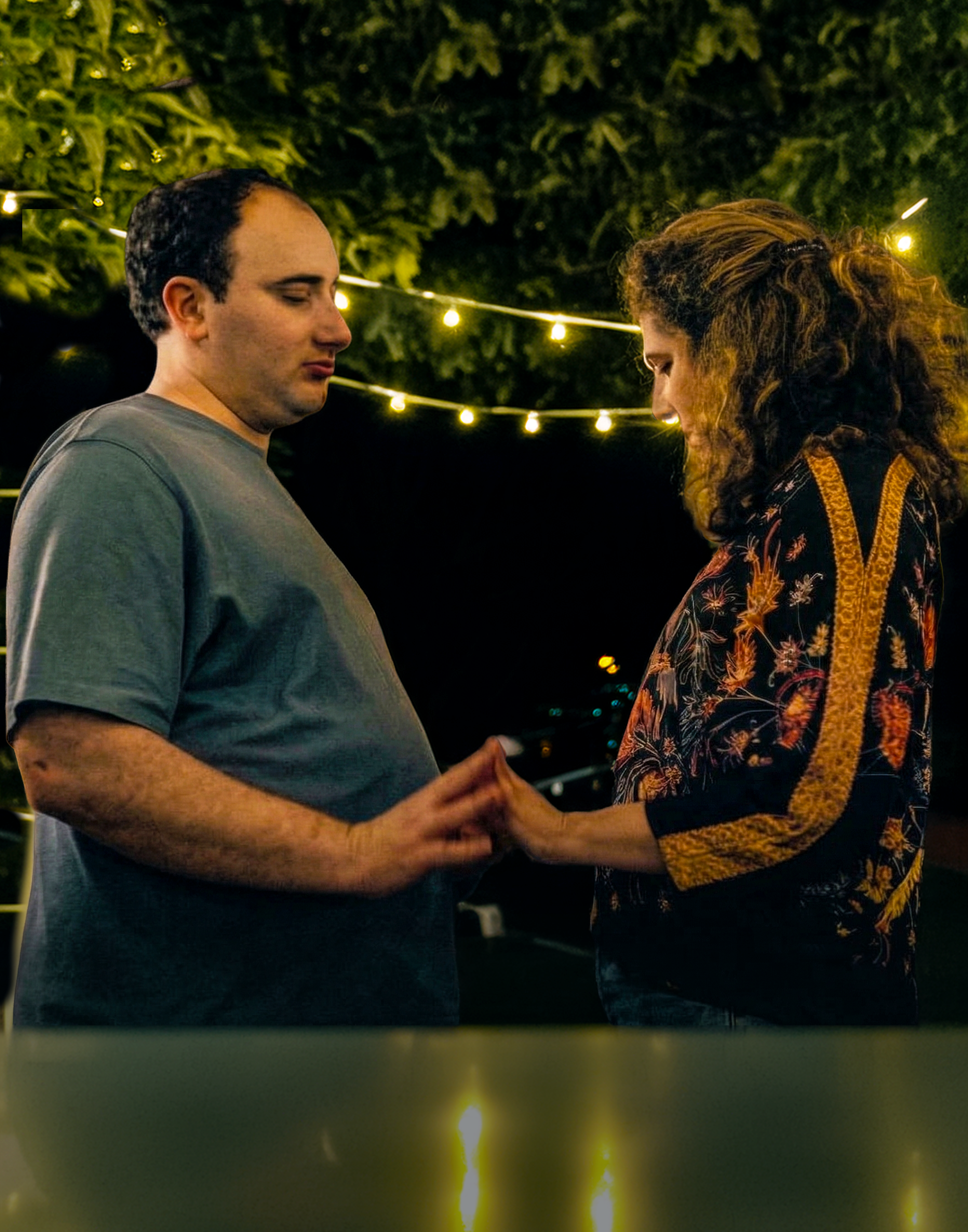
Written by Dan Bergmann — who communicates by pointing to letters on an alphabet board, graduated cum laude from the Extension School at Harvard, and won the university’s open oration competition to speak for his undergraduate class at Commencement (“I thought it would be fun to enter, since I cannot speak”) — the film stars Dan as Francis Morgan alongside Emily Faith Grodin as Claire Montefiore, is directed by Dan’s father Michael Bergmann, and photographed by Dan’s mother Meredith Bergmann, one of America’s foremost public monument sculptors. Each of the three Bergmanns brought their deepest professional skill to the project. The backstory spans fifteen years and includes a Harvard commencement address, a national monument, and a CBS Sunday Morning commentary.
Pointing Fingers is the first feature-length fiction film written by and starring people with minimally-speaking autism.
Come for the backstory, stay for Francis and Claire.
When Francis and Claire, a couple with minimally-speaking autism, are wrongfully accused of murdering their aide, they must bring the real killer to justice to prove their innocence while facing extreme social bias.

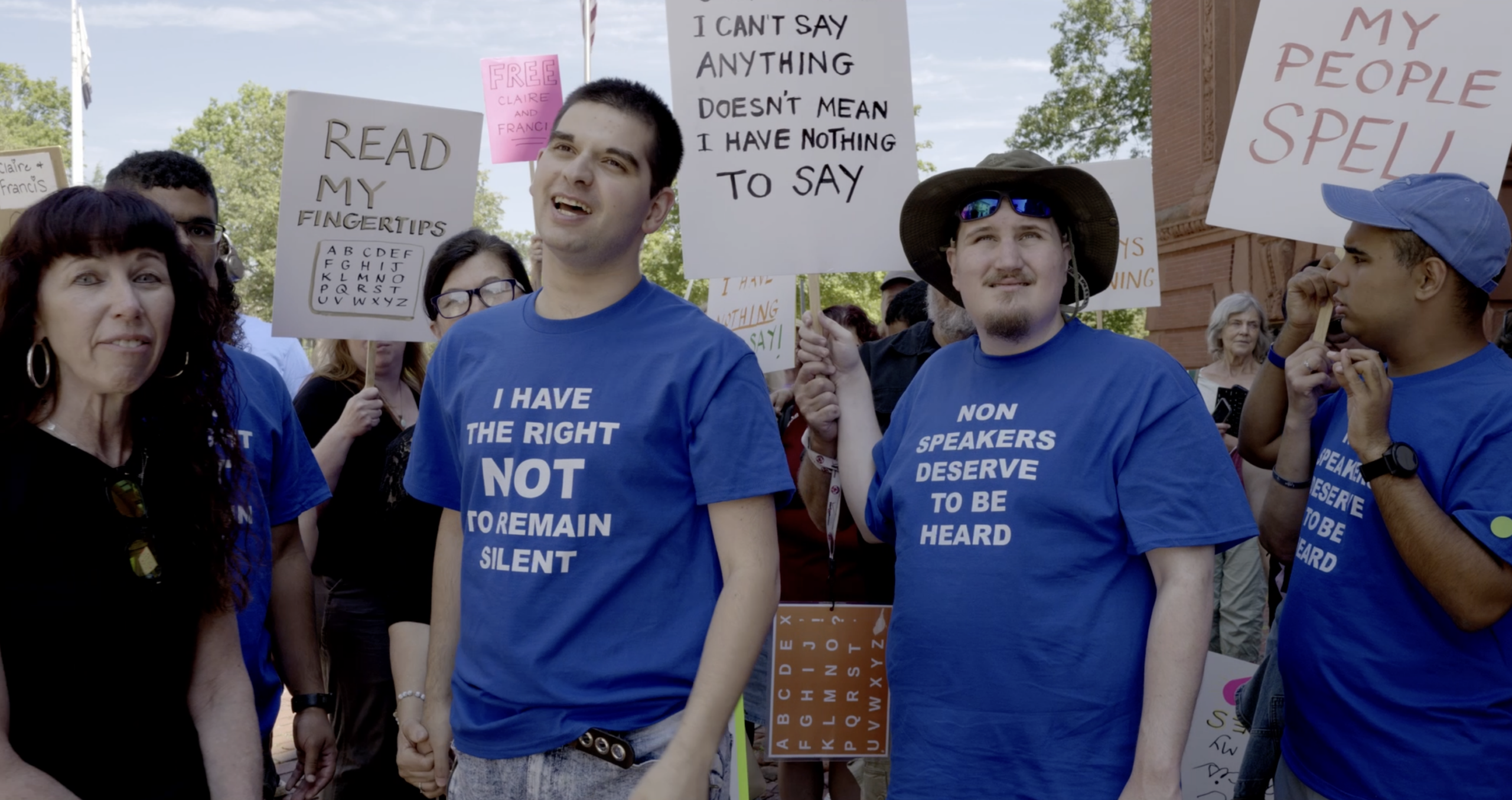
“I wanted the most diverse cast and crew possible in Pointing Fingers, and as many differently-abled actors as we could reasonably cast. This is because I want to evoke a world, aspirational at the moment but hopefully normal in the near future, in which very diverse people function together as if it’s perfectly normal to do so.”
– Dan Bergmann
The Story Behind The Story
“When I was twelve years old, I suddenly learned to think, all at once, on a single day.”
That is Dan Bergmann speaking — writer of Pointing Fingers, Harvard graduate, public intellectual — describing the moment on July 7, 2008, when a gifted teacher named Soma Mukhopadhyay sat across from him and asked him which of two things was more important. No one in all his years of special education had ever asked him to compare two ideas. He was crying when the session started but stopped crying the moment he was considering the question. Thirty-seven minutes in, he produced his first spontaneous word. Before that day, by his own account, he had made meaningless noises, waved his arms, and had no clear sense of time or death or the other building blocks of the human condition. He could not speak, and still cannot — his autism is a severe motor disorder, but not a cognitive one. And on that single July day, because he was making language rather than just hearing it, his mind began to wake up.
That summer, his father Michael began reading him A Midsummer Night’s Dream — one couplet at a time, asking questions about rhyme, meter, jealousy, and metaphor. It took seven months to finish the play. “I can hardly imagine a better way to use the time,” Dan later said. He immediately asked for another Shakespeare play.
Four years later, at sixteen, Dan enrolled in ModPo — Al Filreis’s online Modern and Contemporary American Poetry course at the University of Pennsylvania. It was, he said, “for the first time, a curriculum not adapted to my special needs.” Because the course was online, Dan could run around the room and shout during the video lectures, then come back to answer the questions. At the final webcast, Dan was present in person. Filreis asked participants for two words summing up the experience. Dan’s contribution — “Not Impossible” — was read aloud to the room at Kelly Writers House. The room erupted in applause. It became a thing. One of the other students — 75,000 were enrolled online — started a forum thread called “Not Impossible” and people wrote in their new aspirations: “If Dan Bergmann could complete ModPo, then I can do [whatever they had been wanting to accomplish but thought would be too difficult]…” And Dan discovered that he, who needed so much help, could inspire other people.
From there: Penn, then Harvard Extension School, where Dan studied comparative literature, philosophy, and the classics. When Harvard held its open oration competition, Dan entered. “I thought it would be fun to enter,” he noted, “since I cannot speak.” He won. He delivered his commencement address, speaking for the Harvard Extension School undergraduates via text-to-speech synthesizer, at his Commencement when he graduated cum laude in 2021.
That same year, he gave the closing speech at the unveiling of a national monument: his mother Meredith Bergmann’s FDR Hope Memorial on Roosevelt Island in New York City, a bronze sculpture of FDR in his wheelchair reaching toward a girl on crutches who represents Hope. At the podium, Dan referred to the influence of his own autism on his mother’s sculpture: “I introduced your sculptor, years before she won this commission, to the catastrophe of disability.” Then he offered the words that have become his philosophical north star: “Devastation, however, is not the whole story and we are here today to celebrate the idea that it need never be the whole story.”
Pointing Fingers is where all of this arrives.
The film is a family work in the fullest sense. Dan wrote it. His father Michael directs. Dan stars in the film as Francis Morgan — communicating, as in life, by pointing to letters and words — alongside Emily Faith Grodin, who also lives with nonspeaking autism, and who stars as Claire Montefiore. Meredith Bergmann, whose public sculptures stand in Boston and Central Park, on Roosevelt Island and in other parks in other cities, served as Director of Photography. Each of the three Bergmanns brought their deepest professional skill to every scene.
The mystery holds, the love story earns its ending, and the silence at the film’s center — the particular, charged silence of people whose minds are fully present and whose bodies will not cooperate — turns out to be one of the most expressive dramatic tools a filmmaker could ask for. The eighteen years between the moment Dan first learned to spell and the completion of the film are present in every frame: in the precision of the writing, in the confidence of the performances, in the knowledge that the people on screen are not merely being “represented.” They are “speaking” for themselves.